
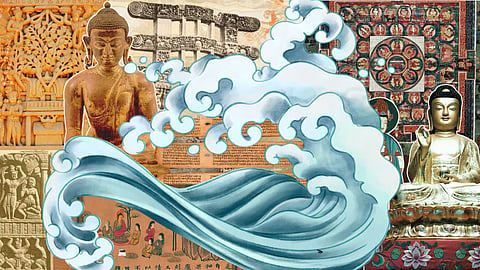
The demise of Buddhist philosophy in Southasia and its journey to the east
IT IS DIFFICULT to write about Indian Buddhism with any certainty even though its world-historical importance is not in doubt. Its decay in India from around the 13th century CE presents an evident difficulty, but subsequent developments were to make the task even more intractable. With the passage of time, its legacy of texts and philosophical ideas was ruthlessly effaced to the point where its chief custodians came to be located in Tibet or East Asia. It was Tibetan scholars who defined the doctrinal schools of Indian Mahayana and fitted them into a coherent narrative; most of its texts survive only in Chinese translation. The enormous literature of Buddhism left no legatees in its homeland, with the partial exception of Nepal.
Its physical remains were ransacked for building materials or obliterated by the elements, only to be rediscovered by colonial scholars during the 19th century. Their sheer abundance indicates the vitality of Buddhism for over a thousand years through successive waves of expansion and contraction. Unfortunately, its followers proved to be as lax as their Hindu counterparts in keeping records or writing down facts: much of our information about Indian Buddhism comes from Chinese pilgrims like Faxian, who visited India early in the 5th century CE, and Xuanzang, who reached eastern India in 633 and stayed until 643. Their journeys testify to the adaptability and fertility of the basic teaching, its ability to attract disparate cultures. In this essay, I examine the philosophical ideas of Buddhism across two culture-spheres, the Indic and the Sinic, to see what they can tell us about its history in India. Its soteriological and philosophical elements are fused – Indic culture, unlike the Grecian, lacked a dividing line between religion and philosophy – but it is possible to separate them in a limited way, for limited purposes.