
📚Southasia Review of Books - February 2025

📚 26 February 2025
Hello reader,
Welcome to another edition of the Southasia Review of Books!
On our latest SaRB Podcast episode, I spoke to the historian Manan Ahmed Asif about his new book Disrupted City: Walking the Pathways of Memory and History in Lahore (The New Press, October 2024).
From the role of memory and violence, as well the city’s people, their survival and questions of nationalism, Disrupted City explores the impact of imperial and state power and dislocation on this Southasian city.
Inviting readers to walk with him across Lahore, Asif also contemplates how the city has been made and unmade over the years, while challenging the narratives and erasures of the Pakistani nation-state and its larger project of re-writing history.
This episode is now available on Spotify, Apple Podcasts and Youtube.
📚Reviews from Himal’s pages this month
📚 This month in Southasian publishing
The longlist for the International Booker Prize 2025 has been announced, and a Kannada translation features for the first time in the prize’s history with Heart Lamp (Penguin India, April 2025), a short story collection by Banu Mushtaq, translated by Deepa Bhasthi.
In 12 stories, published originally in Kannada between 1990 and 2023, Mushtaq captures the everyday lives of women in Muslim communities in southern India, and brings together narratives of love, loss, resilience and the human condition.
“This recognition is not just personal but a significant moment for Kannada literature,” Bhasthi tells Penguin. “That the everyday experiences of South Indian women building lives under patriarchal pressures have resonated with the distinguished jury, and hopefully, will soon reach a global readership, is both humbling and affirming. It is a testament to the universality of Banu Mushtaq’s stories and to the power of translation.”
[Read Deepa Bhasthi’s writing in Himal’s pages, including her short stories and reviews, here.]
Literary festival season
The Nepal Literature Festival returns to Pokhara from 27 February to 2 March. Organised by the Bookworm Foundation, this 12th edition of the festival will feature over 200 prominent voices, including authors, artists, journalists, and scholars, with over 50 discussions on all things art, literature, film and more.
Also in Nepal, South Asia Speaks and Katha Satha Nepal are launching How I Write: Writers on Their Craft (Harper Collins India, December 2024) edited by Sonia Falerio this Friday 28 February at 3 pm at Taragaon Next amphitheatre in Bouddha, Kathmandu. Drop in for a conversation with the writer Manjushree Thapa and Himal’s editor Roman Gautam – also featured in the book – joined by the writer and translator Dinesh Kafle, who was a 2024 South Asia Speaks Fellow.
On identity and ugliness
“How do power and beauty join forces to determine who is considered ugly? What role does that ugliness play in fomenting hatred?” The Afghan-born author and artist Moshtari Hilal’s new book Ugliness (New Vessel Press, February 2025), translated by Elisabeth Lauffer, combines personal memoir with a broad cultural lens to question norms of appearance with a fascinating mix of essay, poetry, her own art, and cultural and social history of the body.
(Dis)order in Karachi’s manufacturing economy
In 2012, over 250 workers of Ali Enterprises, which produced jeans for the German discount retailer KiK, died in a fire in their Karachi factory. While some blamed the exploitative fast fashion industry, others suspected foul play by political actors. Taking this disaster and the resulting controversy as its starting point, Gunpoint Capitalism: Enforcing Industrial Order in Karachi by Laurent Gayer (Hurst, February 2025) plunges into the power structures and daily labour struggles underpinning the manufacturing economy in Pakistan’s industrial capital.
New writing from Michelle de Kretser
A new novel from the Sri Lankan-born Australian writer and twice winner of the Miles Franklin Award Michelle de Kretser follows a writer looking back on her young adulthood and contends with colonialism, gender politics and the gaps between our values and our actions. With Theory & Practice (Catapult Books, February 2025) de Kretser brings a bold experiment in form.
Masculinity in new Indian fiction
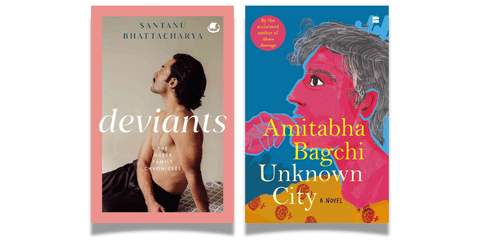
Deviants: The Queer Family Chronicles (Tranquebar/Penguin February 2025), Santanu Bhattacharya’s second novel, follows the lives of three gay men across three generations: 17-year-old Vivaan; his uncle, nicknamed Mambro, growing up in the mid-1990s; and Sukumar, his great-uncle (and Mambro’s uncle) in 1970s Kolkata. Drawing contrasts and continuities of experience amid legal and cultural shifts in India, the novel tracks how the country’s attitudes to homosexuality have changed over the past 50 years.
Unknown City by Amitabha Bagchi (Harper Collins India, January 2025) is another reflective and deeply personal novel on love, regret and self-awareness told through the narrator-protagonist, Arindam Chatterjee. The nearly fifty-year-old novelist and professor revisits his past relationships as his story unfolds across American university towns and India, where he navigates the complexities of love and masculinity.
75 years of the Indian Constitution
This month marks the publication of Gautam Bhatia’s The Indian Constitution: Conversations with Power (Harper Collins India, February 2025) looking at the Constitution of India as a document that “creates, shapes, channels and constrains power.” Bhatia explores how the 75 years of constitutionalism in the country have been marked by a drift towards centralised and homogenous power within the union executive, and unpacks how certain Supreme Court judgments, especially in recent years, have accelerated this drift.
Southasian queer communities in Britain
Desi Queers: LGBTQ+ South Asians and Cultural Belonging in Britain (Hurst, February 2025) by Churnjeet Mahn, Rohit K Dasgupta and DJ Ritu reveals how diasporic Southasians have shaped LGBTQ+ movements and communities in Britain from the 1970s to the present day. Connecting the history of 1980s anti-racism with the emergence of Black LGBTQ+ and feminist collectives, this new book highlights landmark moments in British queer life, politics and culture through Southasian lives.
Until next time, happy reading!
Shwetha Srikanthan
Associate Editor, Himal Southasian
Thank you for reading the Southasia Review of Books. Are there any authors or new books you would like to see featured? We would love to hear from you. Please write to me at shwethas@himalmag.com.