
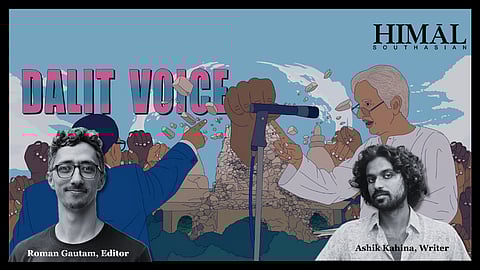
‘Dalit Voice’ and the battles of anti-caste publishing
Dear Reader,
There are a lot of lines that stuck in my mind from Ashik Kahina’s recent Himal story on the magazine Dalit Voice and its very complicated and contentious editor, V T Rajshekar. But this is probably the one that stuck the most: “There is a fearful symmetry between the Brahminical enemies of Indian democracy and its Brahminical guardians.” Ashik, one of the best thinkers and writers of the rising young generation of Southasian intellectuals, unpacks that sentence, and of course much more, over the 7000 words or so of his composition (which, as with all his pieces for Himal, reads so well that you hardly notice the length at all).
After working with Ashik as his editor on this assignment, I sat down with him for a conversation on the story behind the story.It offers even deeper insight into the magazine and its politics, relevant both during its life and in Hindutva-dominated India today. An edited transcript is below, and there’s also the full video of the conversation on YouTube if you’d like to tune in.
All best
Roman

Roman Gautam: To start off, what was the most surprising thing that you found along the way in doing this piece?
Ashik Kahina: I didn't really know much about this subject before you proposed to me that we do this piece. I knew about Dalit Voice magazine and who V T Rajshekar was and I had read maybe one monograph of his before. So the most surprising thing to me was the reach of this guy who previously I had seen as somewhat obscure. He had made connections in many Indian states and various other countries, and worked with all manner of political organisations across the spectrum. He drew in a circle of people who, as I met them one by one, sort of revealed to me this hitherto unwritten history of the anti-caste movement. And not only the anti-caste movement but also the efforts that have been made to make alliances between various Dalit organisations and Muslim organisations as well. These were people who had really closely watched politics from an angle that it's often not observed from. And they had all kinds of dirt, particularly on the various Communist parties and all that in the Indian states. I mean, it's a lot of gossip, a lot of information. But yeah, I would say that that was what was surprising.
Roman: And for me as an editor, it's always fun to hear all of those things; I get to live vicariously through you as a reporter. I also wanted to ask you to briefly tell everybody what Dalit Voice was? And, in your understanding and estimation, what was its project and purpose?
Ashik: Dalit Voice was a magazine started by V T Rajshekar in 1981 after a fairly long career in journalism, primarily with the Indian Express in Bangalore. During his 25 years of working as a journalist, he was also heavily involved in the Communist movement in various cities and in various capacities. He was a fairly committed Communist from the 1950s onwards. So Dalit Voice was kind of the product of his disillusionment with both the Communist movement and with the journalist establishment that he had worked in for many years.
It was both, I think, personal discrimination that he faced in these spaces – primarily from Brahmins – and also deeper ideological disagreements about the centrality of the fight against the caste system in the fight for a just society, which he felt these kinds of establishments ignored. Dalit Voice was an independent magazine that he got together with his various political connections, mostly in Bangalore.
There were some patrons initially, but it was a magazine where the funding was an issue. It was very much a single-editor magazine and one that reflected the vision of a single editor, and it ran for about 30 years, from 1981 to 2011, as an English-language magazine. At that time it drew more and more writers into its orbit, primarily from the emergent Dalit middle class, and it observed political events that happened in this time from V T Rajshekar's perspective.