
📚 Southasia Review of Books - 25 February 2026

Hello reader,
Earlier this month, I took a short trip to Chennai and made a literary pilgrimage of sorts to Higginbothams – India’s oldest surviving bookstore, founded in 1844.
Inside, the shop holds its years lightly. The Italian marble chequered floors, the stained-glass panels, the wooden shelves – all of it feels like a quiet insistence on continuity. And that, I think, is what moved me most. At a moment when brick-and-mortar bookstores are said to be relics, squeezed by e-commerce giants and the general anxiety of our economic times, there is something deeply reassuring about a shop that continues to open its doors every day and trust that readers will walk in.
Yes, some large chains shelf what sells, move what moves. I’m not naive about how capitalism works. But I am sentimental enough to believe that the value of a bookstore can’t be measured in quarterly returns alone. Independent bookshops hold other kinds of wealth – the handwritten recommendation cards, the conversations at checkout that spiral into local literary gossip, the book launches where an author says, “I always dreamed of seeing my book here.”
Across Southasia, bookstores like Higginbothams – and Champaca (shoutout to friends of SaRB!) – anchor their cities in so many ways. When they close, we don’t just lose retail space. We lose a place where reading becomes something shared.
Which local bookstores do you haunt and what do you love about them? Drop me a line at shwethas@himalmag.com.
And just as independent bookstores survive on the faith of their readers, so does independent Southasian journalism. If the Southasia Review of Books means something to you, I hope you’ll consider becoming a paying Himal Patron. Your support keeps this small, stubbornly independent space for regional writing and criticism very much alive.
To contribute more, visit himalmag.com/support-himal.
📚 From Himal’s pages this fortnight
The business of fake deaths in Assam
In this excerpt from Snigdha Poonam’s ‘Scamlands’, forged death certificates and digital loopholes expose massive life-insurance fraud in rural Assam
By Snigdha Poonam
Phanishwar Nath Renu’s story of Nepal’s 1950–51 insurrection
Ratik Asokan’s translation of ‘Nepali Kranti Katha’, a rare eyewitness account of Nepal’s 1950-1951 revolution by a giant of Hindi literature
📚 Spotlight
South Asia Speaks has announced SAS Science, a new year-long mentorship programme for emerging science writers in Southasia. Applications open on 1 March 2026.
Modelled on its flagship fellowship, the fully funded programme offers one-on-one mentorship, masterclasses and workshops tailored to science writing, along with access to the wider SAS community across the region and beyond.
More details here: southasiaspeaks.org/science/
📚 Celebrating Southasian literature
The 2026 Women’s Prize for Non-Fiction longlist was announced this month. Among the 16 longlisted writers is Arundhati Roy, recognised for her first memoir Mother Mary Comes to Me (Penguin, September 2025), an exploration of identity, motherhood and the making of a writer. Also on the list is Lyse Doucet for The Finest Hotel in Kabul (Penguin, September 2025), a people’s history of Afghanistan told through the shifting fortunes of the InterContinental hotel.
📖 From the Himal archives: Supriya Nair reviews Arundhati Roy’s memoir of love, loyalty and the larger-than-life Mrs Roy, puts into perspective a whole career of writing about the problem of belonging.
The Association for Asian Studies also announced this year’s prize winners at its annual conference, recognising outstanding scholarship on Asia, with several Southasian scholars and translators honoured. The A K Ramanujan Prize for Translation was awarded to Sipra Mukherjee and Mrinmoy Pramanick for their translation of Kalyani Thakur Charal’s I Belong to Nowhere (Tilted Axis Press, July 2023).
The complete list of winners, including those of the Bernard S Cohn and Ananda Kentish Coomaraswamy Prizes for scholarly Southasian non-fiction, can be found here: asianstudies.org/aas-2026-prizes/
📚 This month in Southasian publishing
Precarity in the republic
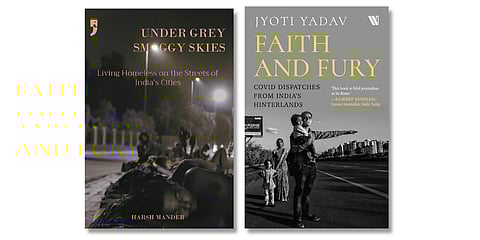
Each night, an estimated three million people sleep rough across India’s cities – navigating exposure, police brutality, hunger and chronic insecurity. In Under Grey Smoggy Skies: Living Homeless on the Streets of India’s Cities (Yoda Press, February 2026), Harsh Mander draws on two decades of work with urban homeless communities to assemble a stark portrait of life at the city’s margins – and a question most of us prefer not to ask: who are the people we pass each day, and what does it mean that we look away?
📖 From the Himal archives: Prashanthi Jayasekara and Vagisha Gunasekara follow a day in the life of a Colombo street cleaner.
When India went into lockdown in May 2020, the journalist Jyoti Yadav travelled across Uttar Pradesh and Bihar to document the first wave of Covid-19 and the migrant exodus that followed. Faith and Fury: COVID Dispatches from India’s Hinterland (Westland, February 2026) gathers that ground reporting into a stark account of the pandemic beyond India’s urban centres – a record of grief, bureaucratic evasion and, at times, resilience.
🎧 From the Himal podcast archives: A conversation with Vidya Krishnan on how India’s politics magnified its Covid-19 death toll.
New Southasian Fiction
Satire under martial law
In Rebel English Academy (Penguin India, February 2026), Mohammed Hanif returns with a darkly comic novel set in a Pakistan unsettled by the execution of a political leader. At the centre is a tuition academy offering affordable English lessons, and refuge. As protest brews and state power tightens its grip, Hanif assembles a vivid cast navigating censorship, desire and dissent.
Empire and the tea gardens
Originally written in Assamese, Arupa Kalita Patangia’s Moonlight Saga, translated by Ranjita Biswas (Speaking Tiger, February 2026), returns to the colonial tea plantations of Assam. Through Durgi – an Adivasi woman transported from central India under false promises – the novel chronicles exploitation, survival and the intimate violences of Empire.
Family, facades and the immigrant dream
In Good People (Crown, February 2026), by the debut novelist Patmeena Sabit, Zorah Sharaf – the beautiful, rebellious eldest daughter of a prosperous Afghan American family – is found dead. Suicide, accident, honour killing? Told through alternating narrators, the novel unravels the mythology of the “model immigrant” household, asking whether the American dream was ever more than performance.
Borders and inherited histories
In Absolute Jafar (HarperCollins India, February 2026), the graphic novelist Sarnath Banerjee traces an Indo–Pak romance strained by decades of nationalism. Their son, Jafar, grows up in Berlin carrying a history he did not choose, while his father clings to fading fantasies of home. By turns wry and melancholic, Banerjee’s latest work meditates on borders, bureaucracy and the uneasy inheritance of memory.
Friendship across continents
Reena Shah’s debut novel, Every Happiness (Bloomsbury, February 2026) follows two women, Deepa and Ruchi, from a Catholic school in India to suburban Connecticut. Intimacy, rivalry, class mobility and suppressed desire shape their decades-long friendship, even as marriage, migration and motherhood complicate what binds them.
A treasury of Urdu short fiction
Edited by Mehr Afshan Farooqui, The Best of Urdu Short Stories (Penguin India, February 2026) brings together a formidable lineage – from Premchand and Ismat Chughtai to Manto, Intizar Husain and Khalid Jawed. The anthology highlights the short story as one of Urdu literature’s richest and most enduring forms, capturing a century of experimentation, dissent and depth.
China and the frontier
In Adversary and Ally: How China Shapes the Frontier Politics of India and Pakistan (Columbia University Press, February 2026), Harrison Akins shifts the focus from high diplomacy to the peripheries, examining how Beijing’s presence has shaped domestic security and governance in India and Pakistan since independence.
Focusing on northeastern India and Pakistan’s Balochistan province, Akins argues that engagement with China has prompted both states to more forcefully assert sovereignty over their frontier regions. By linking international relations to internal conflict, the book offers an account of how great-power politics reverberate through contested borderlands.
Tibet and the politics of memory
Ocean, as Much as Rain: Stories, Lyrical Prose, and Poems from Tibet (Duke University Press, February 2026) introduces a selection of stories, lyrical prose and poems by the Tibetan writer and activist Tsering Woeser. Blending narrative, memory, photographs and documentary fragments, Woeser moves between satire and elegy to trace lives shaped by politics, religion and state power.
Revisiting landscapes and ruins in Chinese-ruled Tibet, she recovers personal and collective histories while reflecting on tourism, ecological strain and cultural erasure. Introduced and translated by Fiona Sze-Lorrain with Dechen Pemba, and featuring an author interview, the volume offers a rare window into one of Tibet’s most vital contemporary literary voices.
📖 From the Himal archives: Palden Gyal traces the predicament and precarity of Tibetan intellectuals in China.
+ Christopher Peacock considers the uncompromising writer Tsering Döndrup’s defiant reckoning with Tibet’s legacy of violence.
The women who made medicine
In Daktarin Jamini Sen: The Extraordinary Life of British India’s First Woman Doctor (Penguin India, February 2026), Deepta Roy Chakraverti traces the life of one of the Subcontinent’s earliest women physicians. Among the first women doctors in British India, Sen later served as physician to Nepal’s royal family, forming a close friendship with King Prithvi Bir Bikram Shah. The biography follows her professional breakthroughs alongside the personal losses and social constraints she navigated, portraying a woman who crossed imperial and gendered boundaries as medicine itself was being remade.
It’s one of several recent books turning their attention to the women who shaped Southasian medicine. In The Woman Who Ran AIIMS: The Memoirs of a Medical Pioneer (Juggernaut, May 2025), Sneh Bhargava reflects on a career that made her the first, and only, woman to head the All India Institute of Medical Sciences, offering a firsthand account of medicine in post-Independence India.
Kavitha Rao’s Lady Doctors: The Untold Stories of India’s First Women in Medicine (Jacaranda Books, September 2023) recovers the lives of six pioneering women from the 1860s to the 1930s – including Anandibai Joshi, Rukhmabai Raut and Kadambini Ganguly – who defied caste, child marriage and social taboo to enter the profession.
In Sisters of Mokama: The Pioneering Women Who Brought Hope and Healing to India (Viking, April 2022), Jyoti Thottam recounts the story of Nazareth Hospital in Bihar, founded in 1947 by Catholic nuns from Kentucky. Drawing in part on her mother’s experience as one of its early nursing trainees, Thottam traces how the women who ran the hospital built a culture of care across caste and religious lines in the years after Partition.
V R Devika’s biography Muthulakshmi Reddy: A Trailblazer in Surgery and Women's Rights (Niyogi Books, May 2022) traces the pioneering surgeon’s work as a legislator and social reformer – from her campaign against the devadasi system to the founding of the Cancer Institute in Adyar.
Until next time, happy reading!
Shwetha Srikanthan
Associate Editor, Himal Southasian
💌 Are there any new books, authors or events you would like to see featured? I’d love to hear from you. Write to me at shwethas@himalmag.com.
📚 Read past editions of the SaRB newsletter, listen to previous episodes and dive into Himal’s Books coverage.
🫰 If you’re enjoying what you’re reading, please consider recommending SaRB to others. Simply share the podcast or newsletter, or sign up here.