

THE INDIAN MIDDLE CLASS has just about had enough. They’re sick of the greedy lalas and corporate bosses who exploit their labour. They’re aghast at the burgeoning handouts to the lazy poor. And they want rid of the incorrigibly corrupt political class.
The validity of this well-worn trope of the victimhood of the middle class has been demolished by generations of scholars. But its grip over the Indian middle-class imagination, and its capacity to by turns stoke and soothe bourgeois angst, remains undiminished.
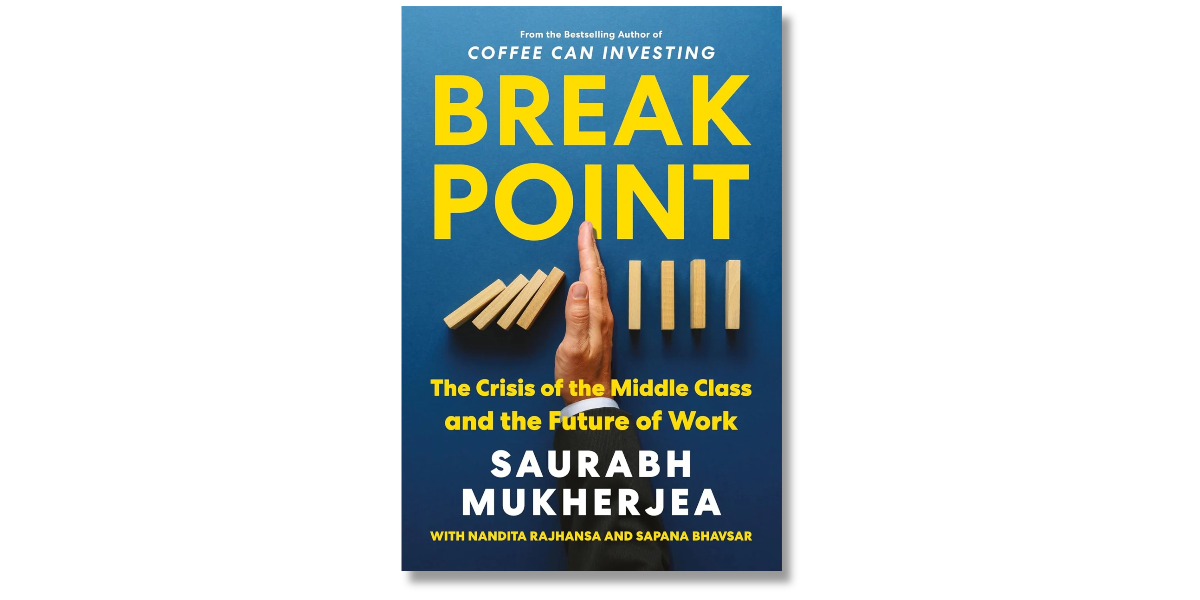
In Breakpoint: The Crisis of the Middle Class and the Future of Work, the fund manager Saurabh Mukherjea and his colleagues Nandita Rajhansa and Sapana Bhavsar attempt to reinvigorate this old trope by marshalling a wide range of economic data and arguments that demonstrate the distress among India’s white-collar workers today. Analysing numbers from the recruitment website naukri.com, they show that white-collar job openings have increased by a measly 3 percent annually since 2020, down from an annual average of 11 percent in the preceding decade.
Mukherjea and his co-authors cite surveys estimating that nearly one in every three people with a college degree is unemployed, and that only a small fraction of engineering graduates secure jobs. They blame this jobs crisis on banks’ restrained lending to companies, slowing sales growth at outsourcing firms, increasing automation and other factors. Even for fresh graduates of IIT Bombay, the most elite of India’s engineering schools, average salaries are falling sharply. A college degree “now actively reduces both your earnings and your chances of employment,” they write.
They also point to the “silent crisis” of middle-class households suffocated by debt. Middle-class mores of an earlier time included a moralistic frugality, but increasingly many households are taking out loans to pay for electronics and travel, in addition to education and healthcare. Close to half of Indian families have taken personal loans, whose repayment wipes out nearly 40 percent of their annual income, according to the authors. This “triple squeeze” – bleak employment prospects, declining salaries, rising debt – is “crushing middle-class prosperity.”
In bemoaning the lack of political debate about these issues, Mukherjea and his co-authors attribute it to “middle class disenfranchisement”. This, for them, is the consequence of a lack of politicians from the middle class, and the group’s relative numerical – and hence electoral – insignificance, among other factors. Politicians “rarely feel the need to cater to the middle class’s interests or listen to its grievances”; instead, they prioritise “the poor for votes and the elite for their money.”
In fact, many of India’s prime ministers and finance ministers since its economic liberalisation in the early 1990s have come from the middle class of old – including P V Narasimha Rao, Atal Behari Vajpayee, Manmohan Singh, Yashwant Sinha, Arun Jaitley and Nirmala Sitharaman. And surely it couldn’t have escaped the sharp authors of Breakpoint that the lack of debate about jobs and wages has something to do with the abdication of duty by India’s middle-class-run newspapers and television channels, and with the cult-like devotion to the prime minister, Narendra Modi, among the same middle class.