

The Inside Deutsche Bank leak was obtained by the Indian author and journalist Josy Joseph and the South African investigative journalist Khadija Sharife. The investigation was coordinated by Barracuda Media NPC in South Africa with technical support from the Data and Research Center (DARC) in Germany.
Leaked documents reveal that Deutsche Bank provided financing related to an offshore gas project linked to the Myanmar military, despite its own sanctions team claiming that it shouldn’t have approved the transaction.
In January 2022, almost a year after the military coup that deposed the democratically elected government of Myanmar, Deutsche Bank received a request from its client, oilfield services company Halliburton, to increase its bond guarantee for operations at the Zawtika gas field offshore from Myanmar.
The original bond guarantee of approximately USD 700,000 had been issued in September 2018 for the benefit of Halliburton’s client PTTEP International Limited, the Thai state-owned oil company and majority owner of the Zawtika field.
The remaining 20 percent stake belongs to the state-owned Myanmar Oil & Gas Enterprise (MOGE), entitling it to a portion of revenues from the project. The subject of the finance was tubing and pumping services for the gas field’s operations.
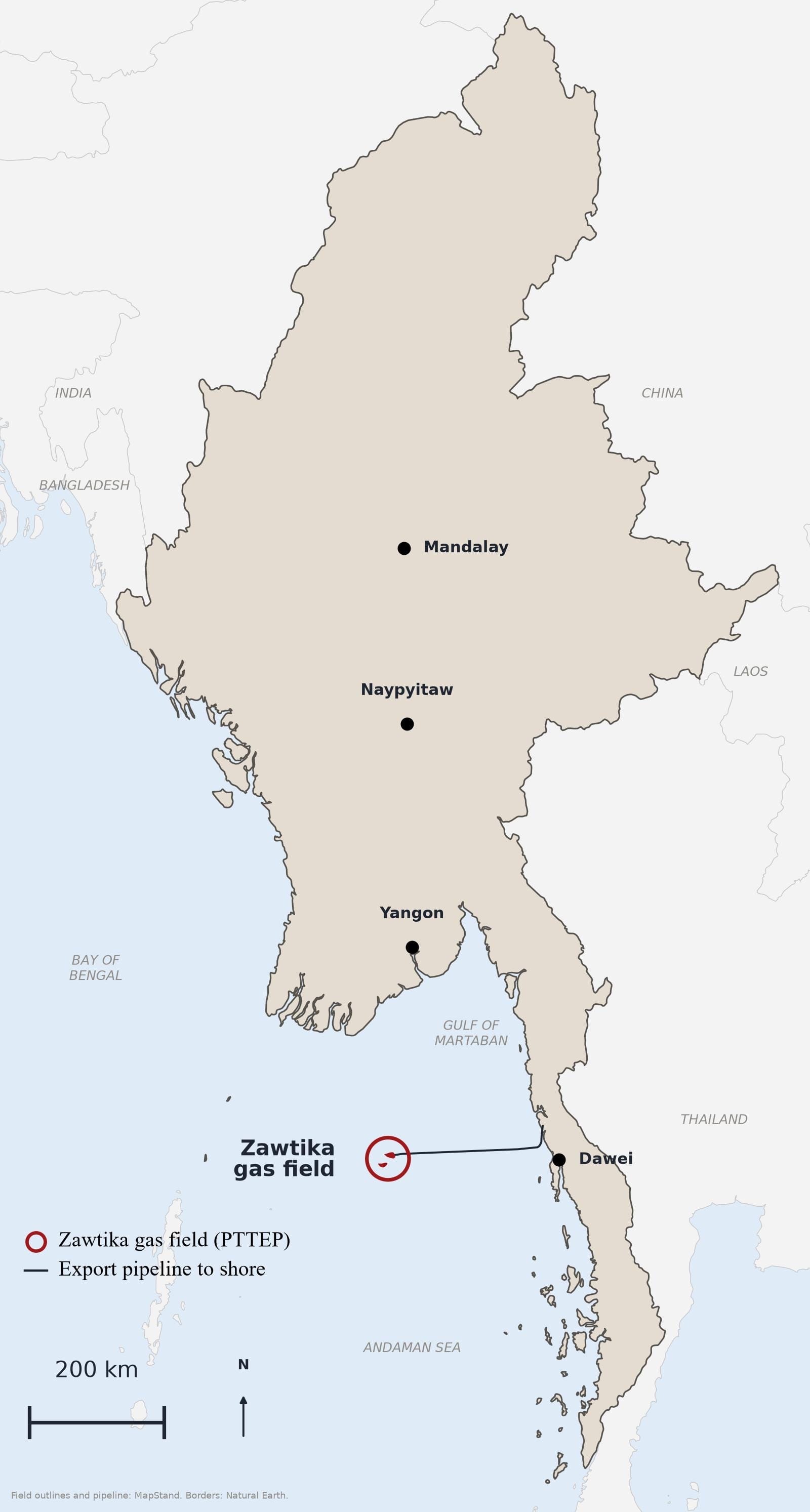
In response to the 2022 request to increase the bond to over a million dollars, a sanctions officer at the bank internally raised concerns that “research shows that the Zawtika Gas Field is owned by the Myanmar Oil & Gas Enterprise (MOGE), and a UN investigation indicated that MOGE is now controlled by Myanmar’s Military Junta.”
Saw San Aye, secretary of the Ministry of Electricity and Energy in the exiled National Unity Government, formerly worked for MOGE and confirmed that “the Zawtika project revenue directly benefits the military council through MOGE.”
A report from civil society collective Publish What You Pay from June 2021 found that revenues from MOGE are the military’s single largest source of foreign exchange.
However, Deutsche Bank ultimately approved the transaction, claiming that its financing was not flowing directly to MOGE and did not involve any sanctioned entity. The bank relied on “client confirmation [of] no military involvement,” suggesting that due diligence was not pursued beyond taking Halliburton’s word.
The leaked documents reveal that within days of the deal being approved, a senior member of the sanctions advisory team raised concerns that “the further increase of the value of the BG [Bank Guarantee] could be seen as facilitating the provision of benefit indirectly to MOGE/Myanmar junta government.”
The staff member’s conclusion was that increasing the bond was not in line with the bank’s objective to reduce or cease exposure to the Myanmar military, and “should hence have been rejected,” asking if “there is any opportunity to roll back on the amendment request.”