
📚 Southasia Review of Books - 31 December 2025

📚 31 December 2025
Hello reader,
Has the final stretch of the year felt like a long checklist that keeps growing the moment you tick something off? Just me? Either way, you know what I’ll say: the last day of December is an excellent time to sit down with a book you’ve been meaning to pick up.
If you’re looking for inspiration, perhaps you can dip into our year-end roundup of Himal’s most-read book reviews of 2025. The selection reflects the breadth of Southasian writing and ideas we covered, as well as the kinds of critical conversations our reviewers helped spark along the way.
We’ve also put together a list of Himal’s top 10 podcast episodes of the year, including a few from the Southasia Review of Books. A number of the titles featured in conversations with the authors on the SaRB podcast were among my personal favourites of 2025 – Saraid de Silva’s Amma and Saima Begum’s The First Jasmines, to name just a few. It’s a wonderful sampling overall, and if you’re feeling stumped about what to read next, you may find something in our year-in-review lists. For further reading inspiration, you can also explore the full playlist of our SaRB conversations here.
We’re running a special year-end campaign to find 100 new Himal Patrons to help carry this work into 2026. Our annual USD 99 membership plan is now 25% off – and it comes with Himal’s iconic Right-Side-Up Map.
Small, independent publications like Himal are more essential than ever, and there’s nowhere else that Southasian books and ideas are given the kind of forum and attention they get here. If SaRB is to survive and grow over the next few years, we’ll need help from our readers like you.
To contribute more, visit himalmag.com/support-himal.
📚 2025 in review
Year in review: Ten great book reviews of 2025
A selection of Himal’s most-read book reviews of the year
Year in review: Ten great podcast episodes on Southasia of 2025
A selection of Himal’s most-listened-to podcast episodes on the region’s politics, culture and society of the year
📚 This month in Southasian publishing
Celebrating Southasian writing and ideas
The Karwaan Book Award, instituted by Karwaan: The Heritage Exploration Initiative, is an annual recognition honouring outstanding non-fiction on the history of the Subcontinent. The 2025 prize has been awarded to Shashank Shekhar Sinha for Casting the Buddha: A Monumental History of Buddhism in India (Pan Macmillan, December 2024).
The jury also awarded a Special Mention to Being Hindu, Being Indian: Lala Lajpat Rai’s Ideas of Nationhood by Vanya Vaidehi Bhargav (Penguin India, February 2024).
📖 From the Himal archives: read Manoj Mitta’s review essay on how Bhargav’s biography traces the Indian freedom fighter’s ideas on nationalism and caste – and how, when read alongside Gandhi’s, they illuminate the often counterintuitive caste politics of India’s Hindu and “secular” nationalisms.
In the shadow of the Himalaya
In the Margins of Empires: A History of the Chicken’s Neck by Akhilesh Upadhyay (Penguin India, December 2025) explores the lives of communities across the Eastern Himalaya – from Nepal and Bhutan to Sikkim, Darjeeling and Tibet. Upadhyay traces centuries of trade, scholarship and cultural exchange, showing how these borderlands, wedged between giants, have shaped their own futures while remaining connected across the region.
📖 From the Himal archives: Amish Raj Mulmi writes on how recent books on the Himalaya exhibit ways of seeing, or failing to see, the mountains and their people.
Food capitals of India
In the Beginning there was Bombay Duck: A Food History of Mumbai by Pronoti Datta (Speaking Tiger, December 2025) traces the city’s culinary history from the Kolis, who have fished its waters since long before recorded history, to early settlers like the Pathare Prabhus, migrants during British rule, and communities such as the Sindhis who found refuge during Partition. Celebrating Mumbai’s rich diversity of cultures and cuisines, the book highlights the people who made the city a gastronomic pilgrimage for food lovers.
From the King’s Table to Street Food: A Food History of Delhi by the food historian Pushpesh Pant (Speaking Tiger, October 2024) explores what it means to be an ‘asli Dilliwala’ – a true-blue Delhizen – and the cuisine that defines the city. Drawing on historical records and literary sources, Pant examines Delhi’s food culture across periods, showing how the city became a melting pot of flavours and culinary traditions.
📖 From the Himal archives: Debolina Dey writes on food and representation, online and offline.
Empire, archives and afterlives
The Indian Caliphate: Exiled Ottomans and the Billionaire Prince by Imran Mulla (Hurst, December 2025) traces the extraordinary story of the last Ottoman Caliph, exiled by Atatürk, who attempted to reconstitute the Caliphate in the princely state of Hyderabad. Charting the downfall of two Muslim dynasties, the book recovers a largely forgotten history: that India was, in many ways, an epicentre of the Islamic world in the early 20th century.
In Worldly Afterlives: Tracing Family Trails Between India and Empire (Princeton University Press, December 2025), Julia Stephens excavates the hidden histories of Southasian migration under empire. Working across imperial archives and family collections, she follows migrant lives across the Indian Ocean to show how colonial governance endures in memory and material traces today, offering a fresh social history of migration and empire.
📖 From the Himal archives: read Sohel Sarkar’s review essay on how Waiting on Empire by Arunima Datta resurrects the largely forgotten travelling ayahs – one of the many groups of Southasian migrant workers in the British Empire.
Politics and power in Rajasthan
From Dynasties to Democracy: Politics, Caste and Power Struggles in Rajasthan by the journalists Deep Mukherjee and Tabeenah Anjum (Pan Macmillan India, December 2025) examines the state’s political evolution, shaped by feudal legacies, social divisions and the influence of royal families. Drawing on firsthand reporting and archival research, the book explores caste violence, Adivasi mobilisation, the power struggles between the BJP and Congress and the influence of the RSS, offering a detailed portrait of Rajasthan’s complex political landscape.
New fiction
Set amid the political turmoil of Bengal, Aurko Maitra’s The Spider (Seagull Books, December 2025) is a gripping tale of inherited violence, mercenaries and myth. Drawing unsettling parallels with contemporary conflicts, the novel interrogates autonomy and survival in conditions of chaos, while tracing the legacies of political violence across generations.
Feeling Kerala: An Anthology of Contemporary Malayalam Stories edited by J Devika (Penguin India, December 2025) brings together some of the sharpest contemporary fiction from the region. Moving beyond familiar 20th-century framings of Kerala, the collection captures a state shaped by migration, transnationalism and multiple, often conflicting, lived realities.
📖 From the Himal archives: Mohamed Shafeeq Karinkurayil explores how celebrated Malayalam novelist Benyamin’s fiction upended the illusions of Gulf migrant lives in Malayalam literature.
In Rohan Monteiro’s The Waking Dead, the protagonist Samir’s attempt to free his falsely accused sister pulls him into a world of killings, demons and supernatural intrigue. As the mystery deepens, it becomes clear that the true antagonist is something far more human, and far more greedy.
Tibetan art in transition
Painting Thangkas on the Tibetan Plateau: Buddhist Art Making in Transition by Xue Ming (University of Washington Press, December 2025) offers a rare, deeply researched look at Rebgong thangka painters and the evolving tradition of Tibetan sacred art. Focusing on a major artistic centre since the 18th century, the book explores how painters – particularly women, newly allowed to practice in the 21st century – navigate artistic tradition, state narratives and shifting markets in contemporary China.
📖 From the Himal archives: Yangdon Dhondup explores how a new generation of artists are pushing the boundaries of what is known as “Tibetan” art and how this reflects important aspects of contemporary Tibetan culture.
Unearthing India’s past
The Dig: Keeladi and the Politics of India’s Past by journalist Sowmiya Ashok (Hachette India, December 2025) traces the discovery and excavation of the contested Sangam era Keeladi settlement site and the political debates it sparked. Moving from Iron Age sites in Tamil Nadu to the Harappan city of Rakhigarhi in Haryana and the lost port of Muziris in Kerala, Ashok blends sharp insight with humour to reveal how science and politics continue to shape our understanding of India’s past.
📖 From the Himal archives: Sudharshan Seneviratne writes that the answer to conflict resolution in Southasia requires an acceptance of our archaeologically proven multicultural, textured past.
Icons of Hindi literary life
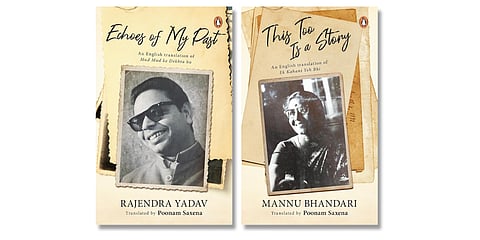
Echoes of My Past by Rajendra Yadav, translated by Poonam Saxena (Penguin India, December 2025), is a candid, provocative memoir by a stalwart of Hindi literature. A founder of the Nayi Kahani movement and a champion of Dalit writing, Yadav reflects on his life, his complex marriage to the fellow Hindi writer Mannu Bhandari, his writing process, and the challenges of editing Hans – the oldest and one of the most prestigious Hindi literary magazines.
Also out this month is Bhandari’s biography, This Too Is a Story (Penguin India, December 2025), translated by Poonam Saxena. The book traces her life and work as a fiery and outspoken writer, exploring the fault lines of her controversial marriage to Yadav and her struggles to claim her place among Hindi literature’s leading voices.
📖 From the Himal archives: Profiling another icon of Hindi literature, Kinshuk Gupta looks at how two new translations recall the lasting legacy of the Hindi playwright Swadesh Deepak, who disappeared in 2006 but whose critique of power in India remains prescient.
Until next year, happy reading!
Shwetha Srikanthan
Associate Editor, Himal Southasian
💌 Are there any new books, authors or events you would like to see featured? I’d love to hear from you. Write to me at shwethas@himalmag.com.
📚 Read past editions of the SaRB newsletter, listen to previous episodes and dive into Himal’s Books coverage.
🫰 If you’re enjoying what you’re reading, please consider recommending SaRB to others. Simply share the podcast or newsletter, or sign up here.