
📚 Southasia Review of Books - 14 January 2026

📚 14 January 2026
Hello reader,
I hope the new year has been treating you kindly. I won’t join the ranks of folks encouraging you to achieve anything extraordinary right out of the gate. (“Veganuary”? No thanks.) Simply making it to 2026 feels like a win, with all that’s happening in the region and beyond. There is, however, much to look forward to in the world of Southasian literature: the new fiction releases highlighted below include some of my most anticipated reads of the year.
Whether you’re kick-starting a year of reading, trying to get out of a slump or just looking to spend a few hours immersed in a book, read on to find out what’s new in the world of Southasian publishing in January.
Over the next few months at Himal, we’ll be taking stock of how the Southasia Review of Books has been doing, thinking carefully about how we can bring more of the reviews and conversations you love, and working on plans to keep growing our community.
If SaRB has become part of your reading routine, and you’re able to support it, please consider becoming a paying Himal Patron today.
To contribute more, visit himalmag.com/support-himal.
And I’d love to hear what your most-anticipated reads of 2026 are. Write to me at shwethas@himalmag.com – we may feature your response in an upcoming SaRB newsletter.
📚 Essays from Himal’s pages this fortnight
Dalpat Chauhan’s alternative Dalit history of Gujarat
An unsung giant of Gujarati literature, Dalpat Chauhan has fought to reclaim a Dalit history, identity and idiom that resist Gujarat’s exclusivist politics and pride
By Hemang Ashwinkumar
📚 This month in Southasian publishing
Celebrating Southasian writing and ideas
The winners of the 2025 Ramnath Goenka Sahitya Samman, a prestigious literary award by The New Indian Express Group, have been announced early this month. The Kannada writer and activist Chandrasekar Kambara received the Lifetime Achievement Award for his contributions to Indian literature, particularly in Kannada poetry, theatre and folklore-inspired writing.
The Best Fiction Award went to Subi Taba for Tales from the Dawn-Lit Mountains: Stories from Arunachal Pradesh (Penguin India, March 2025), while Sudeep Chakravarti’s Fallen City: A Double Murder, Political Insanity, and Delhi’s Descent from Grace (Aleph, August 2024) won the Best Nonfiction Award. Neha Dixit received the Best Debut Award for The Many Lives of Syeda X: The Story of an Unknown Indian (Juggernaut, July 2024).
🎧 From the Himal Archives: Tune in to our SaRB podcast conversation with Neha Dixit on The Many Lives of Syeda X, where she discusses three decades of inequalities and majoritarianism in urban India through the eyes of a Muslim migrant woman.
Small towns and urban wilds
Will India become one big city? In The Ghosts of Indian Small Towns: A Journey Through Time (Aleph, January 2025), Ruskin Bond reflects on the rapid transformation of India’s towns. “Villages become small towns, small towns become big towns or even cities, and cities become mega cities. In my ninety years on this cherished land, I have seen this transformation take place.” The book is both an elegy for the towns being swallowed by urban sprawl and a celebration of the tranquil, memorable places that still linger across the country.
In Wild Capital: Discovering Nature in Delhi (HarperCollins India, January 2026), the acclaimed nature writer Neha Sinha uncovers the hidden wilderness of Delhi. Tracing centuries-old groves, neglected rivers and urban wildlife, Sinha blends ecological history, human stories and personal reflection into a deep exploration of how we connect to the natural world, even amid the city’s concrete and chaos.
📖 From the Himal Archives: In a review essay examining the politics of space and infrastructure in Southasian cities, Sohel Sarkar shows how everyday mobility, inequality and aspiration shape urban citizenship in India and Pakistan.
Voices on the frontlines in Myanmar and beyond
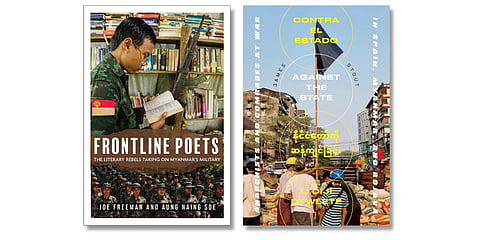
Frontline Poets: The Literary Rebels Taking on Myanmar’s Military by Joe Freeman and Aung Naing Soe (River Books, January 2026) combines contemporary Burmese poetry with the poets’ life stories, revealing the courage and creativity of those who risked everything to resist oppression. From colonial struggles to the fight for democracy today, the book shows how Myanmar’s history can be told through its poets, many of whose voices remain little known outside the country.
In Against the State: Anarchists and Comrades at War in Spain, Myanmar, and Rojava (AK Press, January 2026), the journalist James Stout follows young revolutionaries in Myanmar and Rojava whose non-hierarchical organising, rooted in mutual aid and solidarity, has placed them in direct confrontation with the state. The book examines how anarchist movements have adapted to radically different political contexts, centring the voices of fighters and organisers often marginalised in conflict reporting and misunderstood in Western radical discourse.
🎧 From the Himal Archives: Discussing her new book on the SaRB podcast, Ma Thida, one of Myanmar’s foremost activists and intellectuals, reflects on the country’s political trajectory leading up to and beyond the 2021 military coup and the people’s enduring fight for democracy.
A panorama of Bengali writing
The Bengal Reader: The Finest Fiction, Non-Fiction, Poetry, and Plays from the Bengali (Aleph, January 2026), edited and translated by Arunava Sinha, is the most expansive single-volume anthology of Bengali writing in translation. Spanning the 19th century to the present, it features classics from Rabindranath Tagore, Bibhutibhushan Bandyopadhyay, Sarat Chandra Chattopadhyay and Ashapurna Devi, alongside contemporary voices like Manohar Mouli Biswas and Joy Goswami. Organised chronologically, the anthology traces Bengal’s literary evolution – from early reformist and satirical works to modernist, revolutionary and contemporary writing – offering readers a sweeping view of two centuries of Bengali literature.
📖 From the Himal Archives: Ankush Pal writes about the pioneering Shabdakalpa project, launching in 2028, which aims to digitally map the history of every Bengali word, preserving cultural memory and inspiring future Southasian language initiatives.
New Southasian fiction
In Maryam & Son (Context, January 2026), Mirza Waheed turns the lens away from the spectacle of war to its aftermath. When Maryam Ali’s son disappears and is linked to conflict abroad, she confronts grief, surveillance and suspicion, while navigating a fraught emotional entanglement with a state official. At its core, the novel traces the psychological erosion of families left behind by distant wars.
The acclaimed writer Daniyal Mueenuddin also returns with This Is Where the Serpent Lives (Penguin, January 2026), a sweeping novel of class, ambition and moral compromise in contemporary Pakistan. Moving between feudal estates and chaotic cities, the book follows a web of characters bound by power, loyalty, violence and love, offering an intimate yet epic portrait of a society shaped by caste, capital and corruption.
From Deepa Anappara, the author of Djinn Patrol on the Purple Line, comes The Last of Earth (Penguin, January 2026), an ambitious historical novel set in 19th-century Tibet. Following an Indian surveyor-spy and an English woman explorer on parallel journeys into a forbidden land, the novel interrogates friendship, ambition and the colonial urge to map, conquer and leave a mark.
Unfolding by Rahul Singh (HarperCollins India, January 2026) is set in contemporary Kolkata and brings together the lives of a queer couple navigating intimacy and a working-class Muslim woman rethinking her marriage. Moving beyond familiar queer narratives in literature, the novel explores how love, family and home are negotiated across class, faith and desire, revealing quiet parallels between seemingly disparate lives.
In Good Arguments (Simon & Schuster, January 2026), Deepika Arwind crafts a tender coming-of-age novel set in Bangalore’s theatre world. As Delphi discovers the stage, opens a company, and comes of age amid the protests following the horrific 2012 gangrape, questions of art, politics and ownership of stories begin to collide onstage and off.
Nina McConigley’s How to Commit a Postcolonial Murder (Penguin, January 2026) is a darkly comic, sharply political novel set in 1980s Wyoming. Narrated by a teenage Indian-American girl, it unravels family violence, diaspora identity and colonial history with wit and unsettling clarity, asking what inheritance really means and who bears its cost.
Rebellion in verse
In medieval Tamil regions, a quiet revolution reshaped devotion and society: the Bhakti movement. Rebellion in Verse: Resistance and Devotion in the Tamil Bhakti Movement by Raghavan Srinivasan traces its origins to the sixth century CE, when many sought relief from Vedic orthodoxy and rigid caste hierarchies. The movement’s saints were poets of the people, composing hymns in Tamil that wrested divine wisdom from Sanskrit’s elite grasp and brought it to the masses.
📖 From the Himal Archives: Bharati Jagannathan unpacks the enduring mysteries surrounding a 6th century Tamil poet-saint and her work.
Until next time, happy reading!
Shwetha Srikanthan
Associate Editor, Himal Southasian
💌 Are there any new books, authors or events you would like to see featured? I’d love to hear from you. Write to me at shwethas@himalmag.com.
📚 Read past editions of the SaRB newsletter, listen to previous episodes and dive into Himal’s Books coverage.
🫰 If you’re enjoying what you’re reading, please consider recommending SaRB to others. Simply share the podcast or newsletter, or sign up here.