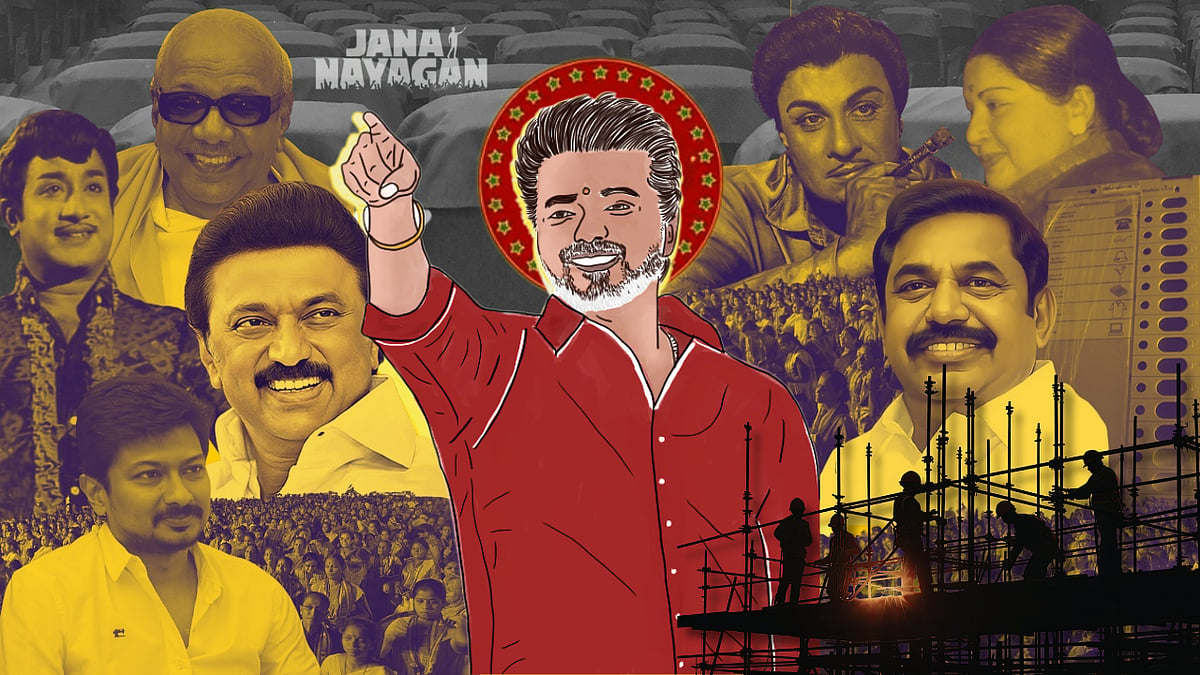
ON 10 MAY, the Tamil mega-star Joseph Vijay stepped onto the dais at Chennai’s Jawaharlal Nehru Stadium to be sworn in as the ninth chief minister of the Indian state of Tamil Nadu. As soon as he appeared, the jam-packed crowd went berserk. Such a response was not new to Vijay, but in the annals of swearing-in ceremonies, this one will be remembered as a watershed moment.
It has been nearly two months since Vijay and his party, the Tamilaga Vettri Kazhagam (TVK), stormed to power in Tamil Nadu, defeating an incumbent government led by the Dravida Munnetra Kazhagam (DMK). The TVK, led by their thalapathy – fans’ moniker for Vijay, signifying a commander or leader – won 108 of the 234 seats in the state legislature, emerging as the single largest party and falling just short of a majority. To say this surprised everyone would be an understatement. Most people thought Vijay and the TVK, as relative newcomers to politics, would garner a decent share of the vote and, at best, pick up a handful of seats as a first step.
Until the shock result, Tamil Nadu’s politics was overwhelmingly dominated by two parties – the DMK and the All India Anna Dravida Munnetra Kazhagam (AIADMK) – that had alternated in power since 1967. Both have their roots in the state’s pre-Independence, anti-Brahminical Dravidian movement, which espoused the annihilation of caste. Later, the DMK aggressively took on the causes of linguistic and regional autonomy, as well as fiscal federalism – all of which pushed back against domineering national governments in New Delhi. The AIADMK was founded in 1972 by the Tamil movie star M G Ramachandran, or MGR, when he broke away from the DMK. Unlike the DMK, the AIADMK largely employed a non-confrontational approach to fiscal federalism and regional autonomy. On the whole, the combination of DMK and the AIADMK resulted in the state’s politics becoming more progressive than that of most parts of India, and ensured major gains in key socioeconomic indicators via caste-based reservations in public employment and education as well as a raft of welfare schemes. But both parties have also been complicit in corruption, nepotism and the persecution of political opponents while in power.
 Vignesh Karthik K R