
📚 Southasia Review of Books - 17 April 2025

Hello reader,
April marks Dalit History Month – observed to coincide with the birth anniversary of the iconic Dalit leader and intellectual B R Ambedkar on 14 April – and with it, a moment to turn to histories told from the vantage point of those long subjected to caste oppression.
In a review essay we published recently, Shainal Verma unpacks how caste survives beneath India’s claims to modernity – both in how deeply it structures everyday life and how effectively it is obscured. Across Southasia, we have not been taught enough, or have not made the effort to learn enough, about how caste has shaped our past and present.
And yet, Dalit writers, thinkers and activists have never stopped writing. What has changed, especially in recent decades, is the scale of their visibility. A rich and growing body of work in English and across regional languages has been steadily reshaping the Southasian literary landscape. These writings carry anger and memory; they document structural violence, but also intimacy, humour and everyday life. Above all, they insist on the complexity of Dalit experience.
Reading these works matters not just because they bear witness, but because they unsettle the terms on which history itself has been written. They ask: who gets to narrate Dalit lives, and whose voices are recognised?
With the Southasia Review of Books, this is something we think about often – how to keep making space for writing that challenges dominant frames, and how to bring these conversations to a wider readership. If this work resonates with you, please consider supporting us to help sustain Himal’s independent, critical journalism.
To contribute more, visit himalmag.com/support-himal.
I’d love to hear what’s on your TBR list this Dalit History Month or any reading recommendations you’d like to share. Write to me at shwethas@himalmag.com.
📚 From Himal’s pages this fortnight
The battle for the ideals of free education in Sri Lanka
Angela W Little’s book spans the original vision and contemporary debates around Sri Lanka’s system of free education, but fails to fully capture its intertwined dynamics of learning, politics and nationalism
By Dhanuka Bandara
📚 Celebrating Southasian literature
The shortlist for this year’s Women’s Prize for Non-Fiction has been announced – a wide-ranging list spanning memoir, politics, biography and writing on science and health. This year’s shortlist includes The Finest Hotel in Kabul: A People’s History of Afghanistan by Lyse Doucet (Penguin, November 2025), alongside Arundhati Roy’s Mother Mary Comes to Me (Penguin, November 2025).
Roy’s book has also been recognised at the National Book Critics Circle Awards – among the most distinguished literary prizes in the United States – where it was honoured in the autobiography category.
📖 From the Himal archives: Supriya Nair’s wide-ranging review essay explores how Arundhati Roy’s memoir of love, loyalty and the larger-than-life Mrs Roy, puts into perspective a whole career of writing about the problem of belonging.
📚 This month in Southasian publishing
Writing against erasure in Nepal
The Other Nepal: Alterity in Nepali Literature and Culture (Cambridge University Press, April 2026), edited by Puspa Damai, brings much needed attention to an underexplored field, addressing the relative scarcity of scholarship on Nepali literature. Moving between canonical and contemporary texts, the essays challenge both orientalist depictions of Nepal as a Himalayan “Shangri La” and reductive development narratives. Instead, they foreground perspectives long marginalised by nationalism, patriarchy and caste hierarchies, offering a more complex and critical account of Nepali society and its literary cultures.
🎧 From the Himal podcast archives: A conversation with the writer Weena Pun on her debut novel Kanchhi, and the invisibility of women in Nepal’s society and literature.
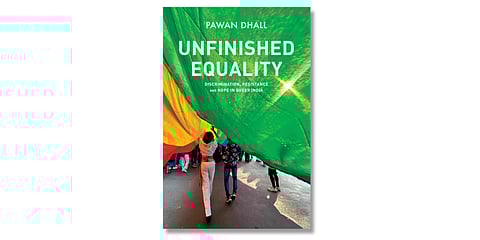
Unfinished equality in queer India
In Unfinished Equality: Discrimination, Resistance and Hope in Queer India (Seagull Books, April 2026), Pawan Dhall examines the state of queer rights in India more than half a decade after decriminalisation. Despite limited legal gains, the LGBTQI+ community in the country continues to face discrimination, violence and exclusion across family, workplace and public life.
Moving between the 1980s and the present, Dhall weaves personal memory with archival research and first-hand accounts to trace histories of survival and resistance. He argues that the push for marriage equality must not overshadow the urgent need for robust anti-discrimination protections, recentering the priorities of the queer movement.
📖 From the Himal archives: Writing on India’s giant step backwards on transgender rights, Ankush Pal and Muskan Tibrewala explain why the hastily passed Transgender Amendment Bill dismantles self-identification rights and walks back on constitutional promises.
Caste, gender and everyday lives
The Monster in Your Path: The Private Life of Caste in India (University of California Press, April 2026) by Sharika Thiranagama unpacks how caste persists in contemporary India despite decades of leftist reform. Drawing on ethnographic work in Kerala, she shows how caste hierarchies have shifted from public life into the private sphere. Centring Dalit women’s experiences, the book traces how histories of humiliation and subordination continue to shape everyday spaces such as the home.
Blending memoir with social analysis, Christina Dhanuja’s Dalit Women and the Fullness of Life (Penguin India, April 2026) challenges reductive portrayals of Dalit women as figures of suffering or resilience without interiority. Instead, Dhanuja foregrounds them as complex, desiring subjects shaped by, but not reducible to, caste and gender.
The India–US migration machine
Wild Wild East: Exiled Americans, Enslaved Indians and the Systemic Abuse of the H-1B Visa Programme by Tanul Thakur (Context, April 2026) offers a forensic exposé of how the H-1B visa system – which allows US companies to hire foreign workers in specialised fields – has enabled widespread exploitation across borders. Anchored in the stories of three men, the book traces a web of corporate fraud, labour violations and immigration abuse linking India and the United States.
Drawing on years of investigation, Thakur uncovers how this system is sustained by firms, institutions and policy frameworks, challenging dominant narratives around high-skilled migration, the Indian IT boom and American exceptionalism.
📖 From the Himal archives: Ambreen Agha reviews Suketu Mehta’s This Land Is Our Land: An Immigrant's Manifesto.
Girmitiya histories in fiction
Shana Chandra’s Banjara (Moa Press, April 2026) is a literary debut novel tracing the legacies of Indo-Fijian indenture across generations and geographies. In 1888, Avani Rathod, a Banjara woman from Rajasthan, is deceived into indentured labour and transported to Fiji, where she forms fragile solidarities aboard the voyage and confronts the brutal realities of plantation life. In 2016, her great-granddaughter Meera Chand sets out from Aotearoa to recover this obscured past, tracing her lineage across India and reconnecting with histories of displacement, memory and desire. Spanning India, Fiji and the Pacific, Banjara reimagines Girmitiya histories while foregrounding the afterlives of indenture.
📖 From the Himal archives: Rajendra Prasad uncovers the story of how the Empire’s forgotten slaves overcame the political legacy of colonialism.
A graphic guide to New India
Discovery of New India by Aakar Patel and PenPencilDraw (Penguin India, April 2026) is a graphic novel that explores politics, governance and public life in contemporary India. Through the chance meeting of two young people from different class backgrounds, the book stages a conversation between nationalism and scepticism. By tracing their brief but revealing encounters, it offers a witty and accessible primer on a decade of political change and its everyday impact.
🎧 From the Himal podcast archives: Harsh Mander speaks with Aakar Patel and Rana Ayyub on whether India under Narendra Modi has shifted toward a Hindu Rashtra.
A History of Kolkata’s Hindu/Presidency College
The Hindu/Presidency College: Excellence and Exclusion (Cambridge University Press, April 2026) examines the layered history of one of Kolkata’s most influential institutions. Founded in the early 19th century as Hindu College and later known as Presidency College, it became a key site for the emergence of liberal arts education and intellectual life in colonial and postcolonial India. Drawing on archival material, the volume foregrounds how its reputation for excellence was shaped by enduring social and cultural exclusions, offering a critical lens on the history of higher education in India and beyond.
Empires, magic and myth
This month features a range of new Southasian-inspired fantasy and historical fiction titles that weave together empire, myth and magic, placing unlikely heroes at the centre of high-stakes struggles.
Burn the Sea by Mona Tewari (Bindery Books, April 2026) reimagines the 16th-century Portuguese incursions into South India through the story of Abbakka Chowta, an unlikely queen thrust into power as sea-borne invaders return. As Ullal faces annihilation, she must navigate war, diplomacy and uneasy alliances.
A Kiss of Crimson Ash by Anuja Varghese (Penguin, April 2026) opens a medieval India-inspired fantasy trilogy, following four lives bound by desire, magic and political intrigue. As a hidden weapon resurfaces, a queen, a prince, a courtesan and a thief are drawn into a high-stakes struggle across courts, temples and underworlds.
The second book of Shannon Chakraborty’s Amina al-Sirafi series, The Tapestry of Fate (HarperVoyager, April 2026), continues the adventures of pirate Amina al-Sirafi, now tasked with stealing an object capable of rewriting fate. As old enemies and supernatural forces close in, she must navigate a perilous game that threatens both her crew and the fragile balance of her world.
The Rise of the Celestials by Kritika H Rao (HarperVoyager, April 2026) concludes the Divine Dancers duology as Meneka is drawn back into the Immortal Realm to confront a demonic threat. Torn between duty and desire, she risks both her bond with Kaushika and her place among the celestials.
Emily Varga’s The River She Became (Pan Macmillan, April 2026) follows a relic-hunter in a Pakistani mythology-inspired world who secretly steals back artefacts from a colonising empire. When her quest leads into a perilous fae realm, shifting loyalties and ancient magic complicate her mission.
The Witch Without Memory by Maithree Wijesekara (HarperCollins, April 2026) continues the Obsidian Throne trilogy as a ruthless empress consolidates power and a captive witch struggles with fractured memories of a dangerous curse. As the empire grows more brutal, alliances strain and impossible choices loom.
Until next time, happy reading!
Shwetha Srikanthan
Associate Editor, Himal Southasian
💌 Are there any new books, authors or events you would like to see featured? I’d love to hear from you. Write to me at shwethas@himalmag.com.
📚 Read past editions of the SaRB newsletter, listen to previous episodes and dive into Himal’s Books coverage.
🫰 If you’re enjoying what you’re reading, please consider recommending SaRB to others. Simply share the podcast or newsletter, or sign up here.